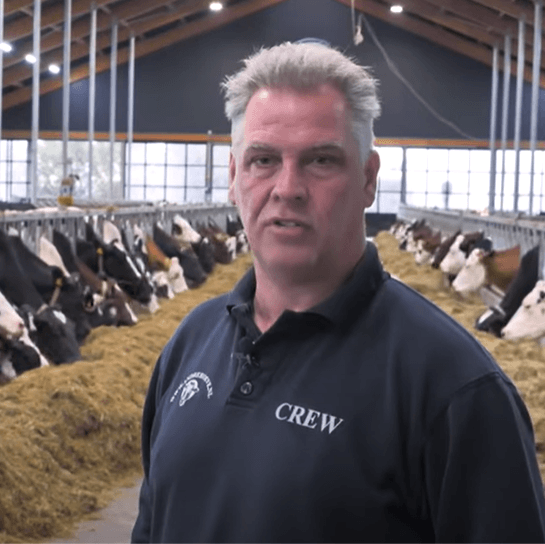

Testimonial: Henry Kloosterboer
The local residents react very positively to this.
In 2012, Henry Kloosterboer took over the dairy farm from his father. Together with his wife and three children, he looks after the dairy cows, including fifty Jersey cows, on a daily basis. Sustainability is an important part of his business, so he buys as little pellets as possible and lets his cows eat more vegetable products. In this way, they try to limit their waste production. “Even if something is not obvious, we look for sustainable options. Biolectric’s digester fits in perfectly with our sustainability principle. The recycling effect is used even better,” explains Kloosterboer.
pure coincidence
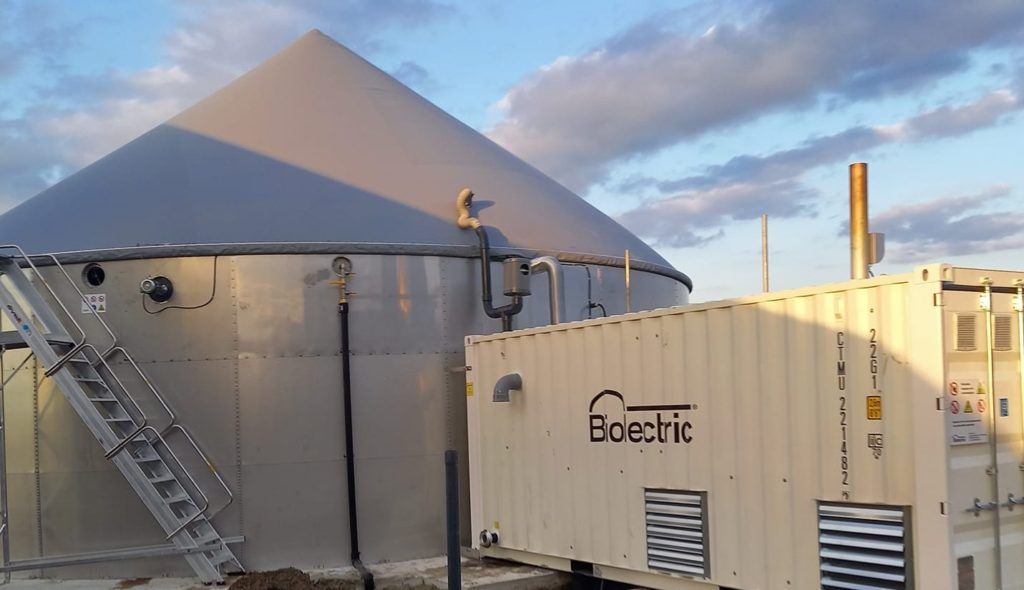
It was a happy coincidence that Henry Kloosterboer came into contact with Biolectric. A representative passed by Kloosterboer’s yard on his way here and saw a large manure silo next to the dairy farm. “At first I didn’t want to know anything about it,” says Henry Kloosterboer, “but after three sentences I was fascinated. The barn has a closed floor and with 180 cows, it creates a lot of manure every day. Previously, the manure was drained into a pit outside the barn and stored from there. That we could use that manure to generate energy? I found that very interesting, because we have a lot of fresh manure here. We can now put it to good use,” says Kloosterboer.
Preparations
First, a few things had to be done. An electricity cable was laid from the meter box to the digester, an internet cable was laid and a water pipe was laid. “My wife is working on a coffee and tea garden, so we immediately took advantage of the opportunity and laid the water pipes through the garden. Kloosterboer is very pleased with the cooperation during the preparations: “There was good consultation, we had a lot of input, we could indicate our wishes and together we looked at the possibilities. Biolectric also first brought 100 cubic metres of manure material twice from another digester, which was supplemented by 5 cubic metres and later 18 cubic metres of manure from the dairy cows. In this way, the manure can heat up faster, to 40 degrees. When this does not happen, the manure is too cold and the digester does not get going fast enough. After a week, they could start the first motor and a week later, the second motor. Now the digester is running at full speed.”
Met de restwarmte willen we een mini-stadsverwarming aanleggen
Great opportunities
The two combustion engines produce heat. A grass drying unit will be installed next to the digester, to dry the grass artificially in the summer. What happens to that heat in the winter? “My wife and I have started talking to a number of neighbours. There are three buildings on the edge of Voorst: a church, a village hall and a primary school. We plan to use the residual heat from these engines to create a sort of mini-urban heating system for these public buildings. The local residents have reacted very positively to this and we are now looking for subsidies from the municipality and province. We are happy when we can give something back to society in this way. That is our strength, identifying sustainable opportunities,” concludes Kloosterboer.

Dairy farm Kloosterboer
Voorst, Gelderland
Familie Kloosterboer
180 diary cowes
of which 50 Jerseycows
30.000 liter per hectare
Hemp, barley and slash-and-burn cultivation
“The mono digester with mineral separator is a fine example of circular agriculture.”

“There is a revenue model.”